How to build a GCSE revision timetable your teenager keeps using
You draw up a GCSE revision timetable. Your teenager finds it too rigid and, within days, has quietly stopped using it. Neither of you has a character flaw to blame. The usual cause is that the plan was written as a contract when it needed to work as a tool.
The Education Endowment Foundation (EEF) hosts a practitioner's guest post on revision routines in which a college practitioner describes exactly this trap: students often pour their nervous energy into "beautifully crafted colour-coded study plans rather than actively engaging in the hard thinking that defines successful revision." This is the view of one practitioner, not EEF guidance. It holds just as well when the plan is the parent's work. An immaculate grid can look like progress while no learning is taking place.
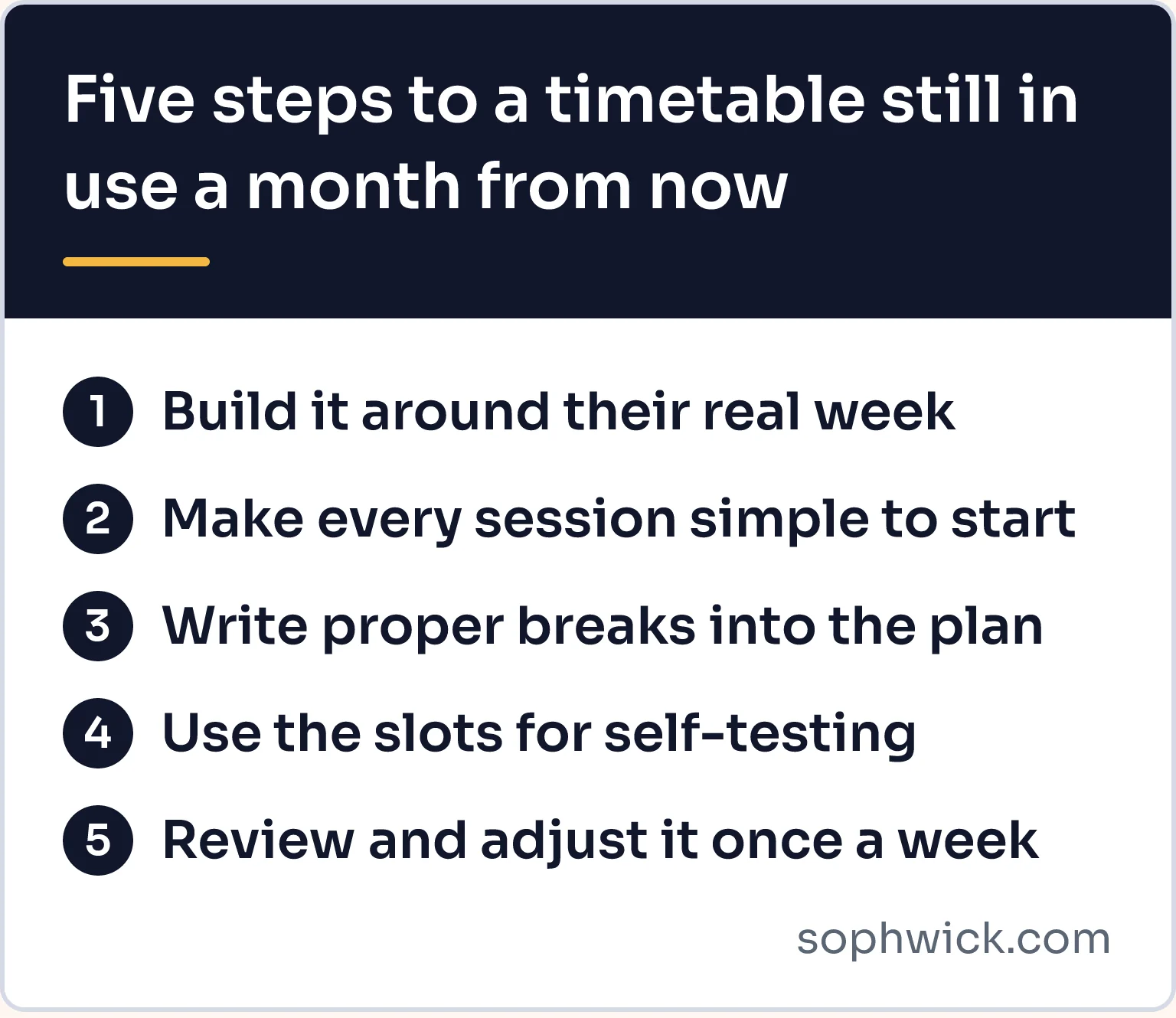
So the aim here is not a perfectly balanced schedule. The aim is a timetable your teenager is still using a month from now. Five steps get you there: build it around their real week, make every session simple to start, write proper breaks into the plan, use the slots for self-testing, and review and adjust it once a week.
Start with the week they already have
A blank grid is where most timetables go wrong, because it ignores everything the week already holds. Before any revision goes in, map out an ordinary week together: school, clubs, sport, any part-time job, mealtimes, screen time, and the points in the day when your teenager is sharp or completely spent. Make this a joint exercise rather than something done to them.
Look for routines that already work. If homework gets done at the kitchen table after tea, revision can sit there too. A slot at an hour when they have never studied is the one most likely to be missed.
Is there a role for the parent at all? The EEF's advice on supporting revision notes that "pupils routinely engage in ineffective revision practices" if the adults around them take it for granted that they can manage alone. Helping with the first draft makes sense. Taking over and writing all of it is usually the point where pushback begins.
Open each session with something easy to start
Getting going is the hardest part of any revision session. Put the easiest, or least unwelcome, task first: a short quiz on a topic they already know well, or flashcards for a subject they enjoy. The point is to be underway by the time the harder work arrives, not to dodge it.
This is practical judgement rather than a research finding: none of the studies cited in this article looked at the order of tasks within a teenager's revision session. What the research does show is that students are not good at telling which study habits pay off. The guest blog mentioned above cautions that re-reading and highlighting give "a false sense of security". So an "easy first" opener should be easy to begin, such as a brief self-quiz, not a passive task that feels useful and isn't.
Write breaks into the plan as real items
AQA's revision guidance asks students to "work out your revision plan and use a planner to help you stay on track; this way you can include time for other commitments and well-deserved breaks." The advice is sound but loose. An instruction like "Include breaks" is the first thing to vanish when a session goes badly, or when it is going well.
Give each break a name, a start time and an end time on the timetable: walking to the shop, having a snack, phone time with a timer on. The guest blog also recommends the Pomodoro technique, "using a timer to chunk down your revision sessions and to bake-in some potentially productive 'spacing'". A timer has a second benefit. It decides when the break is over, so that argument no longer lands on the parent.
Several short sessions are a better bet than one long one. An EEF blog summarising the cognitive science describes spaced practice like this: "we are more likely to remember something we revisit over time than something we study in one sitting, even if the total time spent studying is the same."
So how many hours a day should a teenager revise? None of this guidance puts a figure on it, and a guessed number would not help anyone. Even on spacing, the same EEF blog admits there are "unanswered questions about application", among them "the length of spaces, and whether they should remain consistent or be gradually extended." Begin with what your teenager will really do this week, and adjust from there.
AQA also describes a "ransom technique": "ask your parents to keep your favourite things until you have completed agreed tasks". Because the tasks are agreed, it is less one-sided than its name suggests, and some families do find it helpful. Even so, it casts the parent as the enforcer and turns the plan into a test of obedience, which is exactly what tends to produce "this is too rigid". A break your teenager picked is a stronger lever than a phone taken away.
Use each slot for self-testing, not colouring in
A slot that just says "chemistry" gives no clue about what to do. The activity inside a block counts for more than the block.
The guest blog puts this bluntly: students "can be lulled into a false sense of security from re-reading or daubing their notes in a rainbow of highlighter colours." Its author suggests active methods instead, such as "map from memory": the student writes down everything they can remember about a topic, then checks it against their notes. This is retrieval practice, and it should feel effortful.
The author also sets out a five-stage routine that their own science team teaches: Consolidate, Learn, Assessment, Feedback, Action. Students first boil their notes down, then quiz themselves on them. Putting that sequence into each slot turns "revise chemistry" into a task a teenager can begin and complete.
Retrieval practice, spacing and interleaving (mixing several topics in one session instead of working through each in a long block) have become mainstream. An EEF-commissioned review found that more than 85% of respondents to a teacher survey described these strategies as central to their teaching. The review is also candid about what is not yet known: the strategies "can have a meaningful impact", but evidence on applying them in classrooms "remains limited", and research on their use "in different year groups and subject areas is lacking." The principles are well grounded. No specific schedule is proven by them.
Review the plan together once a week
Most timetables skip this step. Choose a short slot that stays fixed, same day and same time each week, and go through the plan together. Keep the mood relaxed. Four questions will do:
- What did you get done this week?
- What did you skip, and what got in the way?
- Which methods helped, and which only kept you busy?
- What will you do differently next week?
The guest blog's author describes how students at their college "RAG rate their revision techniques" (red, amber, green) to keep track, and suggests this "structured reflection" is likely to help them "calibrate their routines". The EEF's model for teaching revision finishes in the same place, with pupils supported to consider "what went well and what they would do differently next time."
Teaching young people to plan, monitor and evaluate their own learning is well supported by evidence. In its Teaching and Learning Toolkit, the EEF rates these "metacognition and self-regulation" approaches as "high impact for very low cost": an average of +8 months' additional progress, based on 355 studies, with a high security rating. The Toolkit also cautions that "it can be difficult to realise this impact in practice". That evidence is about classroom teaching, not timetables at home, but a weekly review follows the same cycle of planning, monitoring and evaluating.
Watch the tone. The review is about the plan, not about your teenager. When the same slot is missed again and again, ask what is wrong with the slot rather than what is wrong with them. Then move it, cut it down or change the task.
Even a good plan is no guarantee
In a large trial, the EEF evaluated SMART Spaces, a structured spaced-learning revision programme for GCSE science. Pupils at the schools using it "made no additional months' progress in chemistry attainment in AQA Combined Science GCSE compared to pupils in the control schools", a finding given a high security rating. The programme was not poorly delivered: teachers backed it, and 70% said they would be happy to run it again.
In the evaluation's own words, the result "highlights the challenge of translating broad research findings about spaced learning into effective teaching strategies and interventions." A carefully designed programme delivered by teachers fell short. A plan sketched out at home can fall short too.
This is the heart of the checklist. Treat the timetable as a hypothesis you test every week, not a formula to obey. The measures that count are whether your teenager is still using it and whether the weekly review shows them remembering more, not how close it comes to an ideal schedule.
Common advice worth leaving out
Planning is not a one-off job. AQA's advice to "work out your revision plan" and keep on track with a planner is fine as far as it goes. It says nothing about returning to the plan, so build the weekly review in from day one.
Enforcement tools should not be the main lever. The "ransom technique" makes the parent responsible for enforcing the plan. Agreed breaks and a weekly review put less strain on your relationship.
A neat grid is not the goal. As the guest blog quoted earlier warns, colour-coded plans can take the place of the hard thinking revision needs. A messy plan that is used is worth more than a polished one that sits untouched.
Passive methods do not belong in the slots. Re-reading and highlighting are comfortable, and the comfort is misleading: they leave students falsely secure. Put self-testing there instead.
Can a parent manage this without help?
In most cases, yes. Nothing here calls for specialist knowledge. Work from the real week, lower the barrier to starting, timetable the breaks, put self-testing in each slot and hold the weekly review. What tends to be harder is the content of each slot: knowing which topics to test and what a good answer looks like. For self-testing material, Sophwick Academy (currently at virtusacademy.co.uk) is a free GCSE resources site run by the same owner, publishing revision worksheets that drop straight into a retrieval slot.
When the hard part is what goes in the slots
Sophwick Tuition offers one-to-one online lessons in GCSE Maths, GCSE Science and GCSE English for students in the UK and abroad. Prices start at £25 per hour (GBP). The first step is a free 15-minute assessment call, and every enquiry gets a reply within 24 hours.
Sources
Linking to primary sources is part of why this article is worth linking to.
- AQA: Revision support for students and parents
- EEF guest blog: Building study habits and revision routines
- EEF: Supporting revision and the seven-step model
- EEF blog: The ABC of cognitive science
- EEF Teaching and Learning Toolkit: Metacognition and self-regulation
- EEF: SMART Spaces project and evaluation
- EEF: What do we really know about cognitive science in the classroom? (review of the evidence)