Are GCSE mocks accurate? How far to trust a mock grade
Are GCSE mocks accurate? They give a fair picture of what your child has learned up to this point, but they do not predict the summer result. The research gives good reason to pause before reacting to a mock grade, whether it came back low or high.
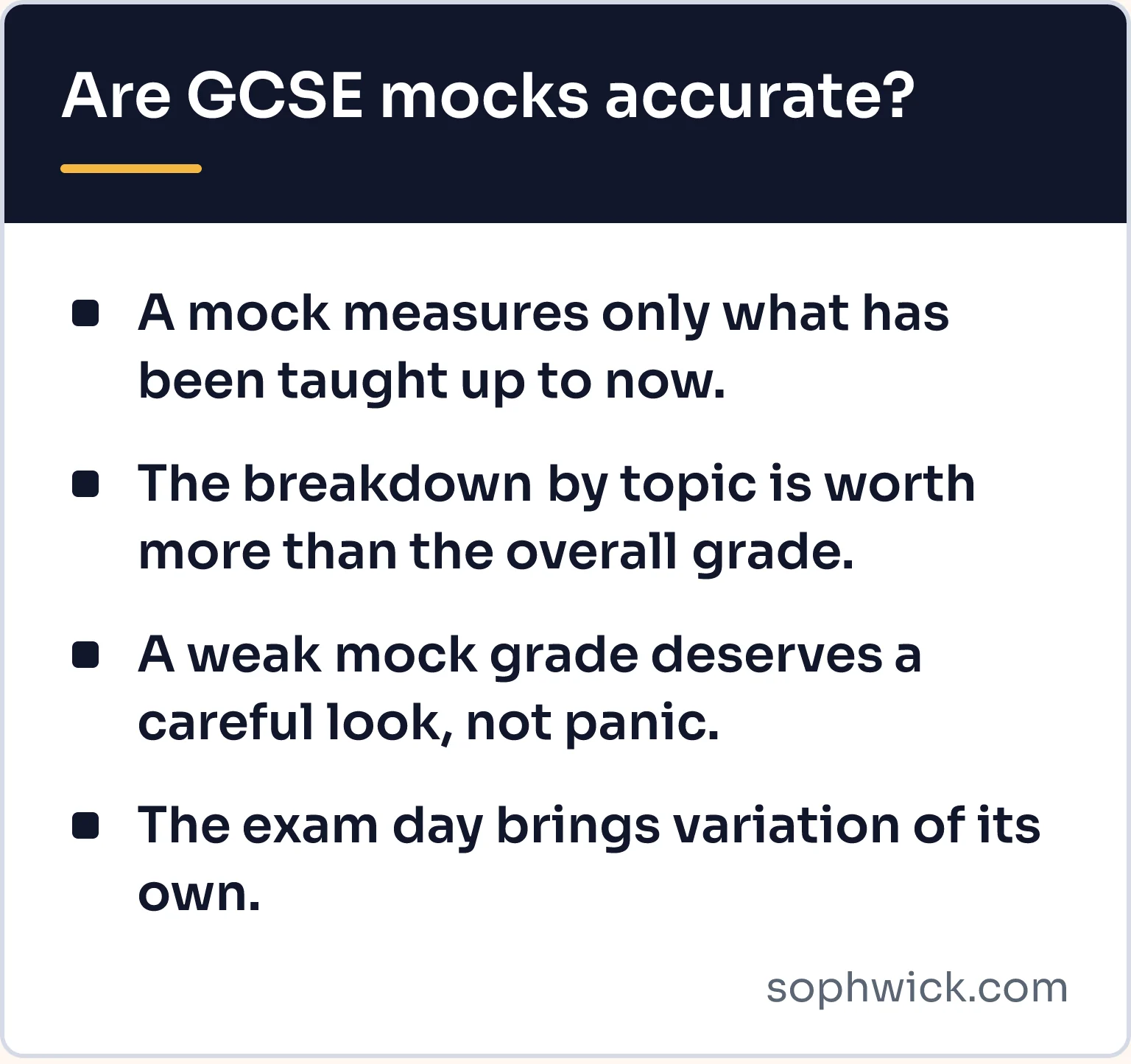
Myth: the mock grade is the summer grade
Plenty of families read a mock as a preview, assuming the grade on the school report will be close to whatever arrives on results day. That is the myth. A mock is really a snapshot: it measures only what has been taught up to now, and nothing beyond it. Ofqual itself keeps these two ideas apart. With exams cancelled in 2020, it asked teachers "to judge the grade a student would have achieved if they had sat their exams". The following year it changed the question, asking them in 2021 to judge "students’ performance on the content they have been taught". Those questions differ, and a mock gives a perfect answer to neither.
Nor was a mock ever the only evidence. Where schools relied on mocks to stand in for cancelled exams, Ofqual lists the evidence as including "mock exam results, marks from work completed throughout the course, and predicted and target grades".
Do grades awarded without an exam come out high?
Looking back at 2020, Ofqual's research found that teachers "tended to give their students the grade they thought they could achieve if they had “a good day” in the exams". No one has measured whether mock grades carry the same lean. Still, keep it in mind when a mock grade sits above what recent classwork would suggest.
Evidence at national level leans in the same direction. In summer 2020 centre-assessed grades took the place of exams, and an evaluation of that year found the grades "were on average around half a grade higher than grades from previous years for both GCSE and A levels". That evaluation also points out that earlier studies "have indicated that teacher grades tend to be more generous than those achieved by candidates in exams".
It is not quite that straightforward, though. A research review finds "ample evidence of teachers’ tendency towards generosity in grade prediction". Yet in England's National Curriculum assessment it found little sign of teachers rating students above what the tests showed. Overseas studies, by contrast, found teachers over-rated much more often than they under-rated. The upshot: generosity is well established when teachers predict grades, and less settled when they assess from day to day.
How often do teachers and tests agree?
The review first looks at exact matches, where the teacher's judgement and the test land on an identical result (known as absolute agreement). It reports that "Over 60% absolute agreement was found in all subjects at KS2 and KS3, except for KS3 English". KS3 English fell below 60%, and so did each area of the curriculum at KS1 too. Even the best case, then, is agreement most of the time, which is a long way from near-certainty.
A looser test asks only whether teacher and test place pupils in a matching order. By that yardstick, KS1 English and maths correlate at 0.74, while KS2 and KS3 range from 0.64 to 0.78. The outlier was KS3 science at 0.25, which the researchers put mostly down to how unreliable that test was.
The review makes one further comparison that parents may find useful. It says that how closely teachers and tests rank students "is of a comparable level to the relative agreement between teacher prediction and actual achievement". Put plainly, on this measure a teacher's view of current attainment lines up with the test about as well as a teacher's forecast lines up with the final result. The review covers teacher assessment broadly, not mocks in particular.
There is a limit to how far this evidence stretches. The studies compare teacher assessment with KS1, KS2 and KS3 National Curriculum tests; they do not compare GCSE mocks with GCSE results. Nothing here shows how frequently mock and summer grades coincide, and no such figure should be made up. Even so, this is the nearest evidence there is, and all of it leans the same way.
Fact: a mock still tells you something real
That does not make a mock pointless. The 2020 evaluation concluded: "The strongest predictor by far of grade outcomes was a candidate’s prior attainment for both GCSE and A level." A student's record so far carries real information, and a mock becomes part of that record: an honest measure of what your child has learned and what is still missing.
The part no mock can capture: the day itself
The exam day is beyond a mock's reach. That year, grades tracked prior attainment more closely, and the same evaluation suggests this may be down to grades "factoring out ‘unpredictable’ variation in student outcomes, seen in normal years due to factors such as exam anxiety, last minute revision or the combination of questions which come up on exam papers". A real exam brings variation of its own, and a mock cannot rehearse all of it.
Ofqual has a vocabulary for this. Assessment error, in its terms, is the gap between what a student "ought to have been awarded" and what they actually got. It divides that error in two: the random kind, "known as unreliability", and the systematic kind, "known as bias". To illustrate random error it gives "the luck of the draw that means you end up having to answer an exam question on a topic you forgot to revise".
Your child's mocks are back: what now?
- Read the grade as a picture of what has been taught up to now, not a prediction.
- Request the breakdown by topic. Knowing which questions lost marks, and the reasons, is worth more than the overall grade.
- A grade close to a boundary is roughly a coin-flip. One teacher Ofqual interviewed put the exam-day odds like this: "roughly half of them will get the higher grade, half will get the lower".
- Look at how prior attainment has moved over time, rather than at the most recent result on its own.
- Let the mock open a conversation about revision rather than close the case with a verdict.
So a weak mock grade deserves a careful look at the topics that went wrong, but it is no automatic cause to panic. A strong one tells you something good about your child's current knowledge, though it guarantees nothing, because the exam day brings variation of its own. Either way, two questions matter: what the breakdown reveals, and how the time between now and the summer exams will be used.
Would a second view of the mock result help?
Sophwick Tuition teaches Maths, Science and English at GCSE, one to one and online, for UK and international students. Lessons start at £25 per hour (GBP). Book a 15-minute assessment call, free of charge, to talk through what the mock breakdown shows; you will hear back from us within 24 hours.
Sources
Linking to primary sources is part of why this article is worth linking to.