Combined science or triple science? Pick the shape that fits
Ask around about combined science or triple science and you tend to hear one rule: the strongest students take triple, and the rest take combined. The descriptions published by Ofqual and the exam boards themselves tell a different story. Combined science is not a cut-down copy of the separate sciences. It is a qualification built to a different shape, and which route suits a student turns on how well they handle breadth and workload just as much as on the grade they are predicted.
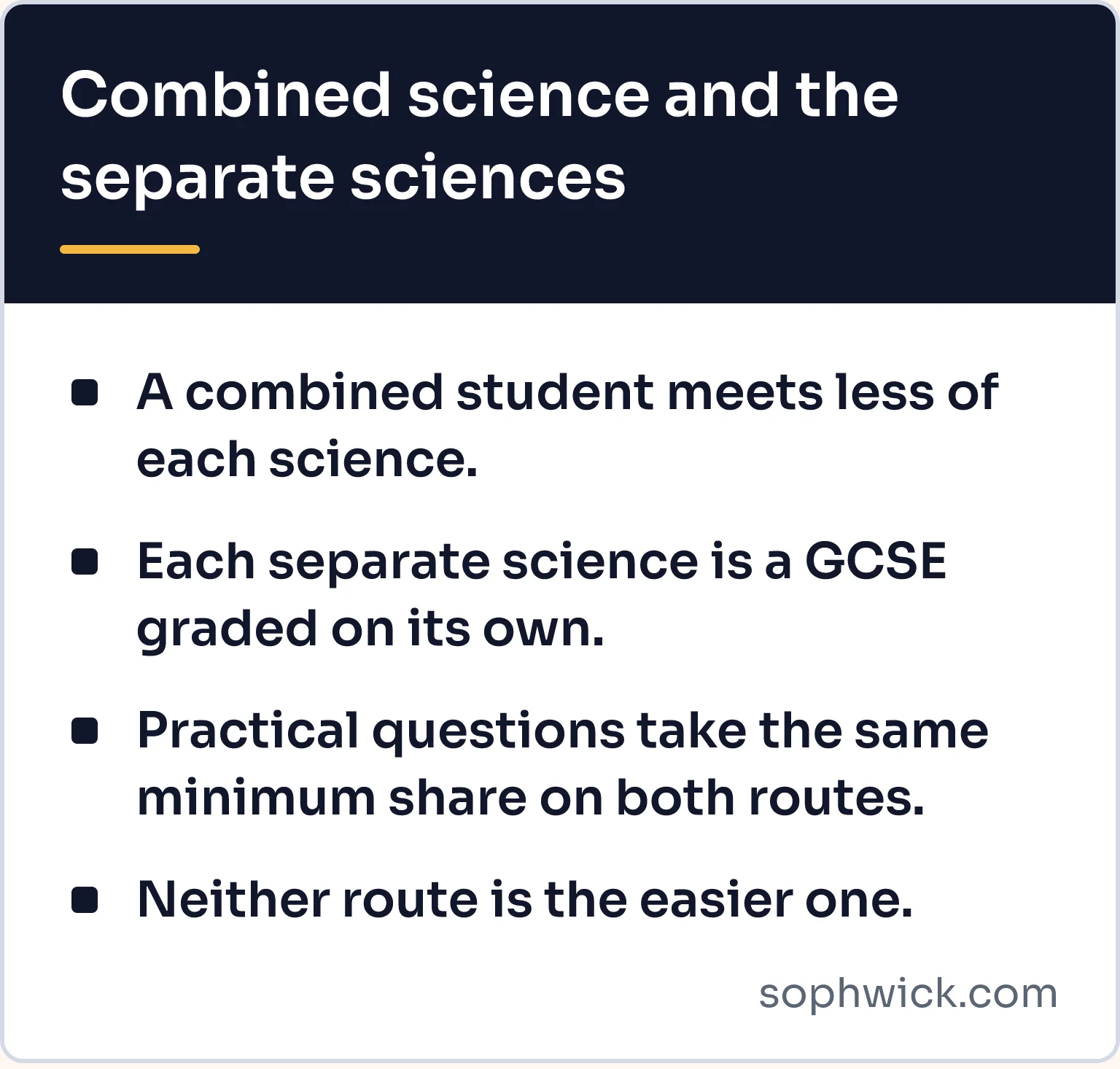
Less of each science, at the same standard
Schools offer two routes. Combined science is a single qualification, an award worth 2 GCSEs, that takes in biology, chemistry and physics together. The separate sciences, which most people call triple science, are individual GCSEs in biology, chemistry and physics, and each one is graded on its own.
In its blog post on how the new science GCSEs are graded, Ofqual says that students taking combined science "will study all three sciences and they’ll cover roughly two thirds of the content of the single GCSEs in biology, chemistry and physics." On the exams, Ofqual's view is that "the overall exam time is similar to that for two GCSEs".
So the cut is in amount, not in standard. A student on the combined route meets less of each science, yet every topic they do meet is drawn from the single GCSEs and pitched at the same level. Any advice that treats less as if it meant easier has got this wrong.
One double grade from three sciences
What a combined science student receives is a double grade, and the award counts as 2 GCSEs. In Ofqual's words: "The double grade will be based on their overall mark across the three subjects; they won’t get a separate mark for each science, and good performance in one area will compensate for weaker performance in another, as in any GCSE."
The upshot is that a single poor physics paper cannot pull a combined grade down on its own. The separate sciences behave differently. Biology, chemistry and physics are each a GCSE with a grade of their own, so a weak showing in physics stays inside the physics grade. The balancing runs both ways, though: on the combined route, strong biology cannot be held apart from weak physics as a grade of its own.
The exams on each route
The exam structure for AQA's version, called Trilogy, is laid out in its Combined Science specification at a glance: "There are six papers: two biology, two chemistry and two physics. Each of the papers will assess knowledge and understanding from distinct topic areas." AQA is not the only board with a combined science qualification, so find out which board your child's school has chosen.
Taking the separate sciences means sitting three complete GCSEs, with a grade for each. How many papers there are on either route, and how long each one lasts, is set out in the exam board's specification, so look at the one for your child's school.
Whichever route a student takes, biology, chemistry and physics are all on the timetable, so moving from one science to another is part of both. Where the workload differs is depth set against volume. Combined science fits all three sciences into a qualification that counts as two GCSEs. On the separate sciences route, a student goes further into every subject and has the content of three whole GCSEs to carry.
Required practicals and what they count for
Each route comes with its own AQA list of required practicals. The list for Combined Science: Trilogy has 21 on it, while GCSE Biology on its own has ten. AQA attaches the same note to both lists: they are "not designed to limit the practical activities carried out by students". On the separate sciences route there are required practicals for chemistry and physics as well as biology, and each subject's specification lists them.
For the exam, the weighting matters more than the list. Both AQA specifications say written exam questions "will draw on the knowledge and understanding students have gained by carrying out the practical activities", and on both routes those questions carry the same minimum share of the total marks.
That undercuts a common belief that combined science goes light on practical work. The set practicals are not identical on each route, yet practical-based questions take the same minimum share of the marks on both.
How many students take each route
Most students sit combined science, and by a wide margin. The official provisional entry figures for England's summer 2026 exam series record 951,510 entries in combined science. Biology has 169,915 entries, chemistry 161,400 and physics 161,305. Each combined student is counted twice in that total, “because combined science is the equivalent of 2 GCSE grades”. Divide it by two to count students instead of grades and you get 475,755.
There is only so much these numbers can tell you. They say nothing about which students picked which route or why, and nothing about how prior attainment or predicted grades compare between the two groups. They are no proof that able students opt for combined science. What they do show is that a student who takes it joins the far larger group, not a remedial one.
Weighing it up for a capable student wary of breadth
The predicted grade is a sensible place to begin, but it settles only part of the decision, and mock grades are less telling than they look. Entry requirements differ from one sixth form to another, so if A-level sciences are on your child's mind, ask the sixth form they hope to join before you decide.
Workload. The separate sciences carry the whole content of three GCSEs. Combined science covers about two thirds of it, with exam time that Ofqual compares to two GCSEs. That gap is a real one for a student whose other subjects already take a lot out of them, and so is the help from a revision timetable they will genuinely stick to.
Breadth. Neither route drops a science. Combined science divides the three across six papers, each on distinct topic areas, so switching between subjects is still part of it. What you are weighing is whether your child does better going deeper into each science or covering less of each.
One weaker science. On the combined route, strong performance in one area makes up for weaker performance in another. On the separate sciences route, a weak subject gets a grade of its own. Neither is the safer bet across the board: it comes down to how uneven your child's sciences are.
The decision itself. Neither route is the easier one. A child who leans towards combined science because of breadth or workload is making a sensible choice, not showing a lack of ambition. Look at sixth-form entry requirements first.
The common framing reduces the whole thing to how clever a child is. It is more useful to ask which shape of qualification fits them: deeper and longer, or broader and more compressed. Either way your child takes a genuine science GCSE, and either route deserves to be a deliberate choice.
Help with GCSE Science on either route
Sophwick Tuition offers one-to-one online lessons in GCSE Maths, GCSE Science and GCSE English for students in the UK and internationally, from £25 per hour (GBP). The first step is a free 15-minute assessment call, and every enquiry gets a reply within 24 hours.
Sources
Linking to primary sources is part of why this article is worth linking to.