GCSE exam season: helping your teenager with sleep and stress
A parent cannot order a teenager to sleep, or to stop worrying. Sleep and stress in GCSE exams are connected, but your real influence sits in a narrower set of places that turn out to be more useful: how the evenings run, how you interpret signs of strain, and how the night before each paper goes.
The pressure matters most during the build-up to the summer exam series, and again in the weeks leading up to mocks, whose timing each school decides for itself. It accumulates gradually across that period, so a teenager who is plainly struggling may have been under strain for some time before it showed.
Where a parent's influence lies
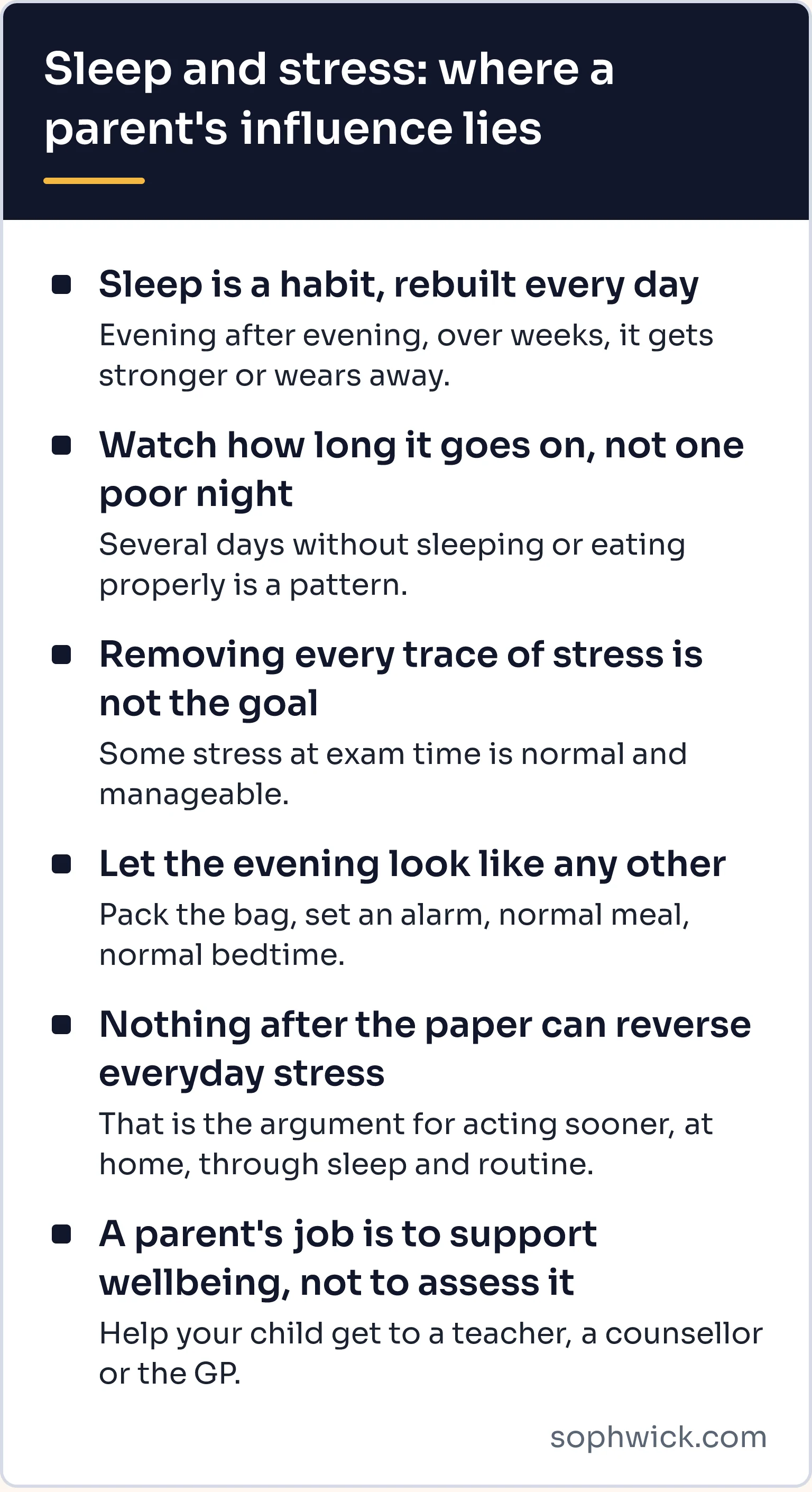
Sleep is a habit, rebuilt every day. Evening after evening, over a matter of weeks, it gets stronger or wears away. Of the three, it is the one you can see most easily.
Background anxiety builds slowly. It sits beneath the surface as a mood. Your influence on it is indirect: the routine you keep, the atmosphere at home, and recognising the moment to bring someone else in.
The night before is brief. It is a small window, yet a handful of practical decisions that evening can make the following morning calmer.
How much does a short night cost in marks?
No one can put a number of marks on a poor night's sleep for your child. The evidence supports something more limited. A guest post on Ofqual's blog points to research by Putwain and Daly suggesting that about 15% of GCSE students may be ‘highly test anxious’. For those students, according to the same research, stress and anxiety run "high enough that their well being and exam performance can be negatively affected".
Sleep belongs within that picture, not outside it. Another guest post on Ofqual's blog passes on a model put forward by Gareth Hughes, a Human Givens psychotherapist working in psychological wellbeing at the University of Derby. In it, academic performance depends on physical, psychological and social needs all being met and kept in balance. The physical strand reads: "Physical health, including sleep, nutrition and exercise". This is one practitioner's framework that Ofqual's blog has hosted; it is not a statement of Ofqual's own view. Its value is its plainness. Sleep forms one part of a balance and does not fix things by itself.
Why May is the pressure point
In a guest post for the Department for Education's Education Hub blog, Childline says that 22% of all the counselling sessions it has given on managing exam stress take place in May. Children who contact it describe finding it hard to fit breaks around revision, "suffering from a lack of sleep and sometimes even having nightmares".
Given that May sits within the summer exam series, the peak is to be expected. The run-up to mocks squeezes in the same way on a smaller scale, which makes it a helpful practice run: the way your child sleeps and copes then gives you a clue about the summer. How far the mock grade itself can be trusted is a different question, covered in what GCSE mock results do and do not show.
Normal nerves or a warning sign?
AQA and OCR begin from the same starting point. AQA reminds students that exam season "can be a stressful and overwhelming time, and it’s completely normal to feel anxious". OCR makes the distinction sharper: "some levels of stress at exam time are normal and manageable", yet "that’s not the same as feeling overwhelmed by anxiety".
What to watch is how long something goes on, rather than one poor night. Among the symptoms where OCR advises students to "seek help" is "You can’t sleep". AQA's list of warning signs includes "not sleeping or eating properly for several days". Tossing and turning before a paper is normal. When a teenager has gone several days without sleeping or eating properly, that is a pattern, and it is the moment to stop handling it on your own at home.
Should all the stress go?
Removing every trace of stress is not the goal. OCR describes some stress at exam time as "normal and manageable"; the aim is to hold it at that level, not to leave your child feeling nothing at all. The same guest post that passes on the Hughes model also sums up research into what helps. Relaxation techniques, it says, "can help alleviate the physiological aspects of test anxiety, such as increased heart rate or feelings of nausea". Skill-building interventions, meanwhile, "result in increased task and examination performance and may result in associated decreases in test anxiety".
For parents, the second finding is the one to hold on to. Feeling better prepared may in itself reduce anxiety, which makes a revision timetable with proper breaks built in worth the work. Bear in mind that the post was about what schools can do rather than what happens at home, so read it as a direction to head in, not a set of instructions.
The evening before a paper
- Pack the bag that evening, with pens, a calculator and whatever else the paper calls for, so there is less to decide in the morning.
- Set an alarm, and settle on a time for everyone at home to be up.
- Let the evening look like any other, with the normal meal and the normal bedtime.
- Steer clear of the subject material, and do not pick this night for a row about how much revision has happened.
- Offer company if your child would like it, and quiet if that is what they would prefer.
There is nothing sophisticated here. The point is that you can control all of it, which you cannot say of the exam paper.
Why exam rules cannot undo built-up stress
Many parents assume that if stress ruins a paper, some allowance will follow. Adjustments do exist, but they cover a tighter set of circumstances than people tend to imagine. According to JCQ's guidance on special consideration, centres must apply only where "an adverse issue or event has had, or is reasonably likely to have had, a material effect" on a candidate's ability to sit an assessment or demonstrate their usual level of attainment. JCQ adds that, even then, special consideration "can only go some way" to help and "cannot remove the difficulty faced by the candidate".
Separate invigilation is meant for a candidate with "a substantial and long-term impairment", for example "long-term social, emotional and mental health needs". The difficulties, JCQ says, "must be well established" and known to staff such as the form tutor and head of year. JCQ also observes that more requests for separate invigilation are being made on the grounds of exam anxiety.
Taken as a whole, the rules lead to one conclusion. They are designed for events that affect a particular assessment, and for needs that are long-term and well established. Everyday stress that has built up quietly across a term of revision is unlikely to meet either test, and nothing done after the paper can reverse it. That is the argument for acting sooner, at home, through sleep and routine. If you believe your child's circumstances could qualify, the school is the place to ask.
Knowing when to hand over
A parent's job is to support wellbeing, not to assess it. For students who notice signs such as not being able to sleep, OCR's advice is: "Talk to your family, a teacher who knows you well, a counsellor at your school or your GP." Family appears on that list, but alongside other people. If the changes you are noticing have gone on for several days, or are getting worse, your role is to help your child get to a teacher, a counsellor or the GP.
Inside that role, Childline's guest post suggests helping children "think of healthy ways to cope", such as doing yoga, breathing exercises or mindfulness together. There is also a guide for students on gov.uk, Coping with exam pressure, developed with Professor Dave Putwain, a researcher at Liverpool John Moores University, which sets out "practical strategies" for GCSE students dealing with exam-related stress. Your child is the intended reader, and that may be its strength: it hands them something they can use without you watching over them.
Are you overreacting, then? Probably not, if what you are noticing is a pattern and not a single night. Lost sleep counts as one part of a wider balance. What a parent can do is genuine but limited: keep evenings steady, make the night before each paper calm, notice how long any change goes on, and recognise when it is time to pass things to the school or the GP.
Concerned that all the revision is not showing up in results?
Sophwick Tuition offers one-to-one online lessons in GCSE Maths, GCSE Science and GCSE English for students in the UK and abroad. Prices start at £25 per hour (GBP). Every enquiry gets a reply within 24 hours, and the first step is a free 15-minute assessment call.
Sources
Linking to primary sources is part of why this article is worth linking to.
- OCR: Managing stress
- AQA: Managing stress
- Ofqual blog (guest post): What is it like to experience exam stress? A student perspective
- Ofqual blog (guest post): What can schools do about examination and test anxiety?
- DfE Education Hub (Childline guest post): How to cope with exam stress
- gov.uk: Coping with exam pressure, a guide for students
- JCQ: Understanding the requirements for separate invigilation
- JCQ: A guide to the special consideration process